Game Rules

It Can Wait @ Chico State

4-6 players

Disclaimer: This game is meant to simulate the actual consequences that accompany texting while driving. Every step and situation should be taken seriously so that all players can completely understand the intended purpose.

Object of the game: To inform players about the risks of texting and driving.

How to play:

  1. Each player will roll the dice, the player that rolls the highest number will start. From there you will play clockwise.
  2. The first player rolls the dice, the number on the dice determines the number of spaces you will move.
  3. Throughout the game you will land on different colored spaces:

Green: You’re safe.

Yellow: Roll an even number and you’re safe. If you roll an odd number, move back three spaces.

Red: Roll a 3 or 6 and you’re safe. If you roll any other number, pick a card from the deck.

*The severity of the card selected will determine whether you move back 4, 5 or 6 spaces.

*When you pick an “It Can Wait” card from the deck, you can save the card for future use and avoid the consequences of moving back spaces when you land on a yellow or red space.

*If any of your actions result in a death, you move back 6 spaces and lose your next turn.

The game ends when a player reaches the finish line.

How to win: The player that reaches the finish line first is the winner.
Game Learning Outcomes

Problem: Texting and Driving

Goal: To eliminate texting and driving while educating individuals about the dangers of texting and driving


Learning Outcomes:

1.  Learn the legal consequences of texting and driving

Performance: The player will have a disclaimer before the game begins and before every turn that explains why texting and driving is unsafe and a potential hazard as well as the legal troubles it can get you into.

Condition: This will serve to set the basis and cause of our game. We want players to understand that we are combatting texting and driving. The disclaimer can be given in the simple form of a fact or even a scenario. We will put all the hazards and laws of texting and driving onto a flash card or incorporate them into a scenario and the flash card will then be put into a deck of other cards with different hazards/laws/scenarios on them.

Standard: The player’s success will be measured by the outcome of the game, if they survived in the end and if they reached their final destination.


2. Understanding the risk of texting and driving

Performance: The concept of rolling the dice in the game.

Condition: The player must roll a dice to bring in the concept of risk and to determine whether or not they will get into an accident. If a player rolls an even number, they can advance to the next space. If a player rolls an odd number, they must return to the first square as they have now been involved in an accident.

Standard: The player’s success will be measured by the outcome of the game, if they survived in the end and if they reached their final destination.


3. Understand the emotional effect of accidents on loved ones

Performance: After rolling the dice you will continue to learn how texting and driving is a matter of probability by choosing from the deck of cards listed “accidents.”

Condition: A deck of cards with realistic scenarios and accidents will be provided to the players. If you roll an odd number, you will choose a card from the deck which will present the accident you were involved in.

Standard: The player’s success will be measured by the outcome of the game, if they survived in the end and if they reached their final destination.

Team Demographics

Assumptions: 

-Ages 15-17

-Teen drivers are more at risk

-People who have been driving for a longer amount of time will be less interested or not interested at all in playing the game (they probably will assume they already know all the risks)

Estimation process: 

-We estimated the age 15 because that is the age teens start to think about driving

-Teen drivers are more at risk of using their phones while driving because they grew up with all that technology

-Drivers who have longer experience driving think they don’t need to play this game from their years driving and having no accidents

Audience size estimate: 

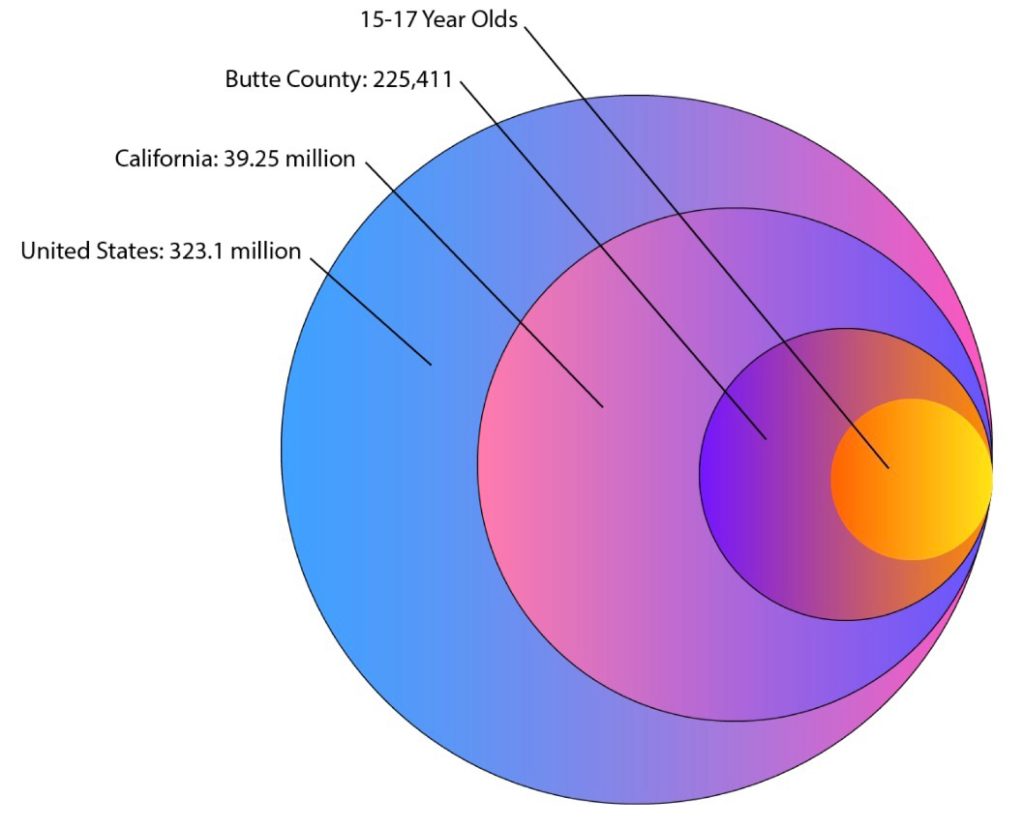
-California residents ages 15-17: 845,557 people

https://suburbanstats.org/population/how-many-people-live-in-california

Chart or graphical representation of estimate: 

Reference data sources: 

suburbanstats.org. “Current Population Demographics and Statistics for California by age, gender and race.” SuburbanStats.org, suburbanstats.org/population/how-many-people-live-in-california. Accessed 20 Sept. 2017.

“California Safety Laws – Cell Phone, Seat Belt, & Car Seat.” DMV.org, www.dmv.org/ca-california/safety-laws.php. Accessed 20 Sept. 2017.

andrew.currin.ctr@dot.gov. “U Drive. U Text. U Pay.” NHTSA, 26 July 2017, www.nhtsa.gov/risky-driving/distracted-driving. Accessed 20 Sept. 2017.

“Motor Vehicle Safety.” Centers for Disease Control and Prevention, Centers for Disease Control and Prevention, 9 June 2017, www.cdc.gov/motorvehiclesafety/distracted_driving/index.html. Accessed 20 Sept. 2017.

Further research: 

Group Persona


Name: Lauren Kelly

Job title: Student

Key information about their work:

Business Major at Chico State University

Details about their role:

Junior, emphasis in Marketing

Demographics

Age: 21

Gender: Female

Salary: N/A

Location: Chico, CA

Education: Undergraduate

Family: Single

Goals and challenges:

Trying to focus while driving.

Finding events in town.

Values / fears:

Values family and friends

Fear of missing out: FOMO

Quote:

“I get bored after class; I wish I knew what was going on today without leaving my dorm room.”

“I always look over at my phone when I hear a notification in the car. I only grab it to check it sometimes.” 

Project Topic/Issue & Timeline for Serious Game

Idea A is an app that eliminates social isolation by encouraging CSU students to attend local events. Our app will be a platform where people can scan their location with a camera or check a calendar where deals and events will pop up and virtually aid students in discovering new places to visit and provide dates to events they can attend. By logging in with their CSU email, students will be able to gain points (creating a game) when checking into places and attending local events or by adding events to the calendar for other students to attend creating a shared calendar. Points can be used within the app to “buy” coupons to local businesses and restaurants.  

Idea B is a game that has a setup similar to Life or Candyland. It is a board game that highlights the dangers of texting and driving. Each player starts at square one with a different game piece. There’s a deck of cards and each card has a text message with a contact name. Each player must decide whether or not they would like to engage in the conversation (only 2 skips allowed per player). After deciding whether or not to pay attention to the message, the person must roll a dice. If a player rolls an even number, they can advance to the next space. If a player rolls an odd number, they must return to the first square. Play continues until someone reaches the final destination.


Timeline:

Choose idea by September 20

Start gathering materials: September 25

Alpha test: October 9-18

Conduct second test before beta test: October 30

Beta test: November 10-11

Sense of Place presentation: December 5